





How much carbon do you need? Stick materials demystified

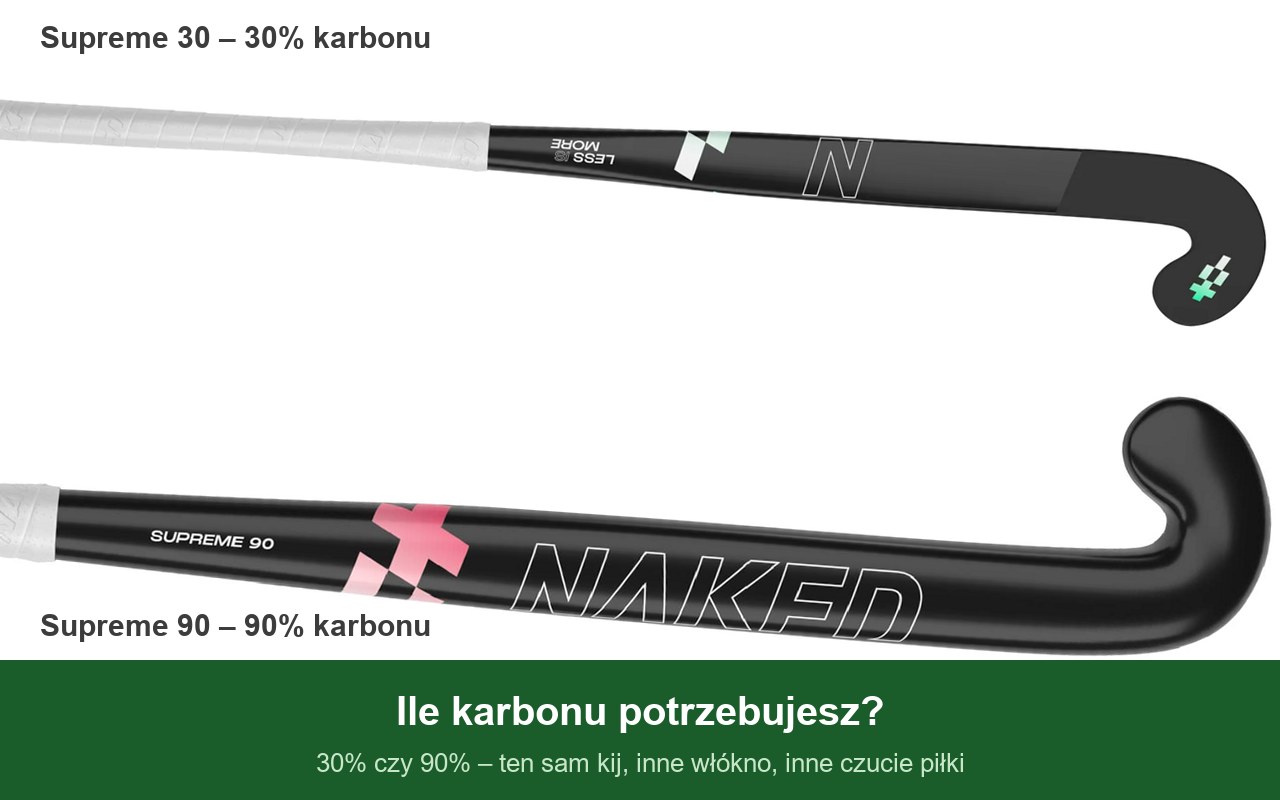
"What is the carbon percentage of this stick?" – it is one of the first questions players ask and the first number manufacturers print in big letters. On the market you will find sticks ranging from models with no carbon at all to ones with 95% carbon fibre. What does that number really mean, what does it do on the pitch and – most importantly – how much carbon do you actually need? We explain it without the marketing haze.
What sticks are actually made of
A modern composite stick is built from layers of several materials, each doing a different job:
- Fibreglass – flexible and springy. It offers good ball feel, forgives imperfect traps and keeps the price sensible. The backbone of beginner sticks.
- Carbon fibre – stiff and light. This is where stiffness and power come from: within a single series, the higher its share, the less hitting energy is lost in the flex of the shaft.
- Aramid (Kevlar) – dampens vibrations and reinforces impact-prone areas, usually the lower part of the stick and its edges.
- Wood – the classic, today found mostly in kids' and recreational sticks: soft trapping, low price, considerable weight.
What carbon really does
Carbon stiffens the stick. A stiffer stick can transfer energy more efficiently with correct technique – on hits and drag flicks less energy is lost in the flex of the shaft, so the shot gains power. How much exactly depends on more than the material, though: technique, head speed, stick weight, the sweet spot and how cleanly you strike the ball all count. A high carbon content is also felt on long-distance passes.
But that same stiffness has a flip side: a high-carbon stick is less forgiving. The ball bounces off harder on an imperfect trap, and a mishit can send an unpleasant vibration through your hands. For a beginner, a stiff stick can therefore make clean contact and control harder – trapping technique has to catch up with the equipment first.
The percentage is not everything
Within the same series, a higher carbon content usually means greater stiffness – and that is the easiest way to compare, e.g. successive models in the NKD Supreme series. Between brands, however, the percentage alone says little: the construction of the stick, the grade of fibre used and the flex matter too, which is why two sticks with the same carbon content can behave completely differently on the pitch. Some manufacturers deliberately do not publish percentages, precisely because the number alone does not describe the stick.
How much carbon for which level
- Beginners and juniors. Mostly fibreglass with a small share of carbon: the stick forgives mistakes, offers good ball feel and teaches proper technique.
- Regular players. A medium carbon content is a common compromise for club players: noticeably more power with a still-reasonable margin for error.
- Advanced and elite players. A high carbon content for powerful hits and drag flicks – for players with a confident trap.
We deliberately give no rigid percentage brackets here, because the same number from two manufacturers can mean a completely different stick. Choose a specific model by the manufacturer's specification and by how the stick behaves in your hands, not by the number in its name.
The myth: more carbon = a better stick
The most expensive stick with the highest carbon percentage is not "the best" – it is best for a specific type of player. A defender who builds play with long passes will appreciate the stiffness, but a technical midfielder who lives off dribbling in tight spaces often deliberately picks a lower carbon content for better feel. Match the material to your game, not to the price list.
Remember, too, that carbon is only one parameter – just as important is the bow of the stick, which we covered in our post on bow profiles, and the right length, which you can pick using our size guide.
How to find it in the store
We list the stick's composition in the description wherever the manufacturer publishes a reliable specification. In the Hockey Sticks category you can filter by length and bow, and if you are looking for a specific carbon content, drop us a line – we will point you to the models that have it.
Still not sure where to start? Read our guide on how to choose a stick or simply email us at [email protected] – we will help you decide before you spend your money.